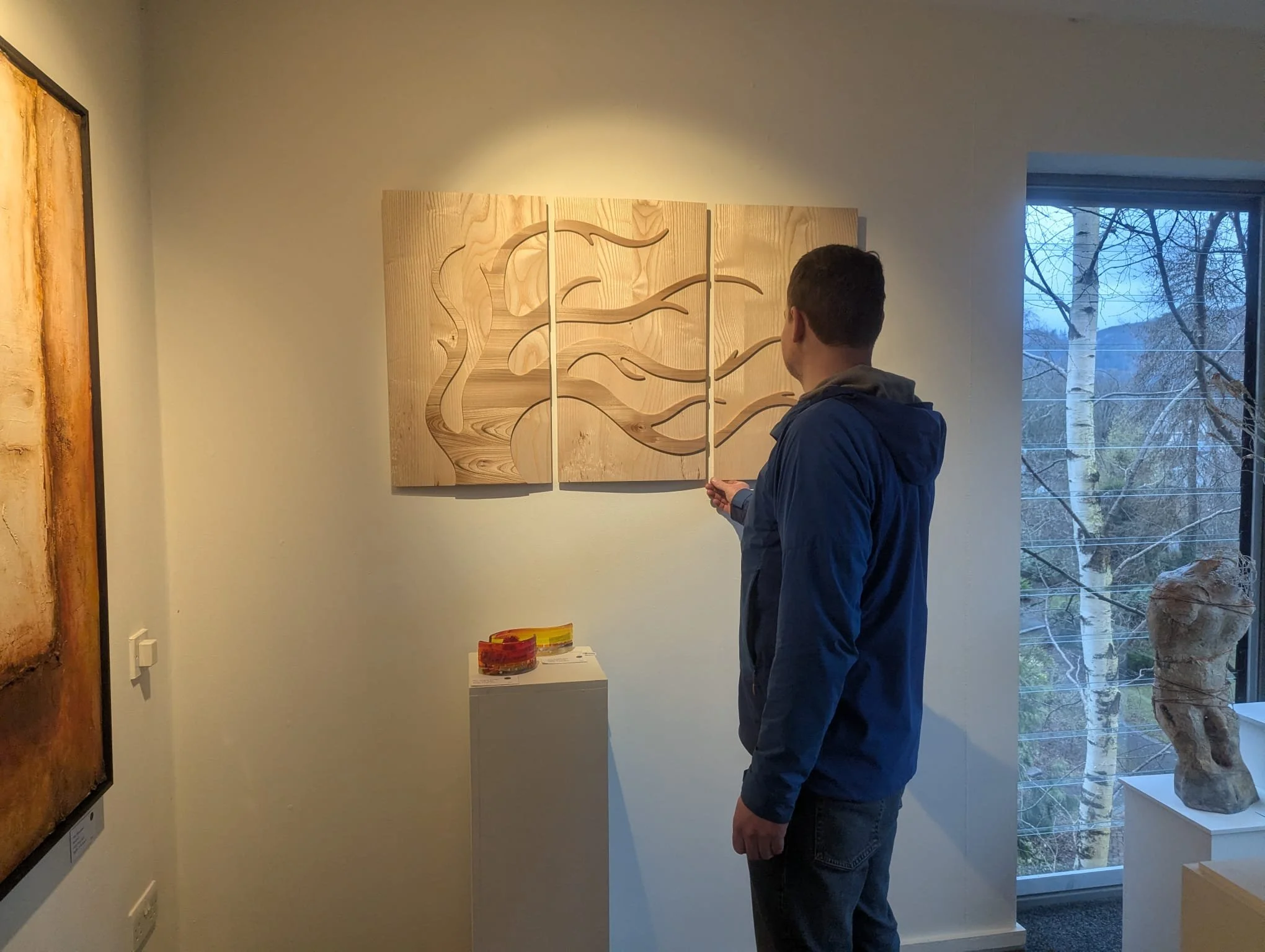
Restorations by Highwood Furniture

From dodgy drawers to tired tables, if your wooden furniture is in need of a little TLC then Highwood Furniture is the place to be.

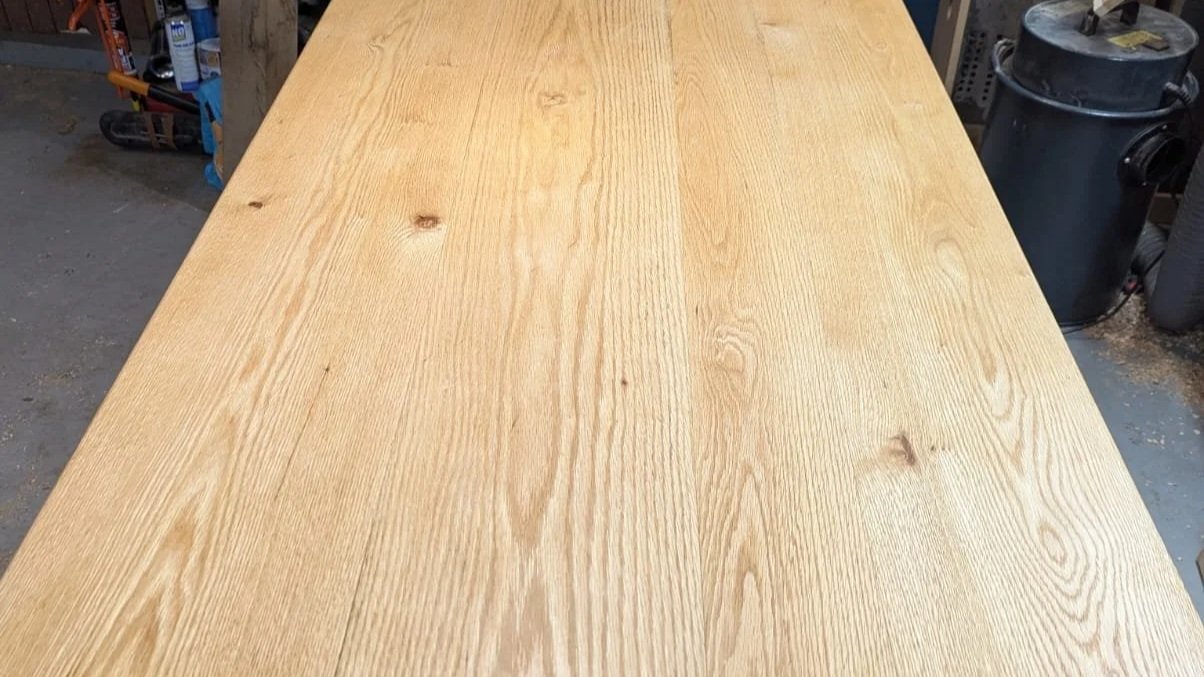
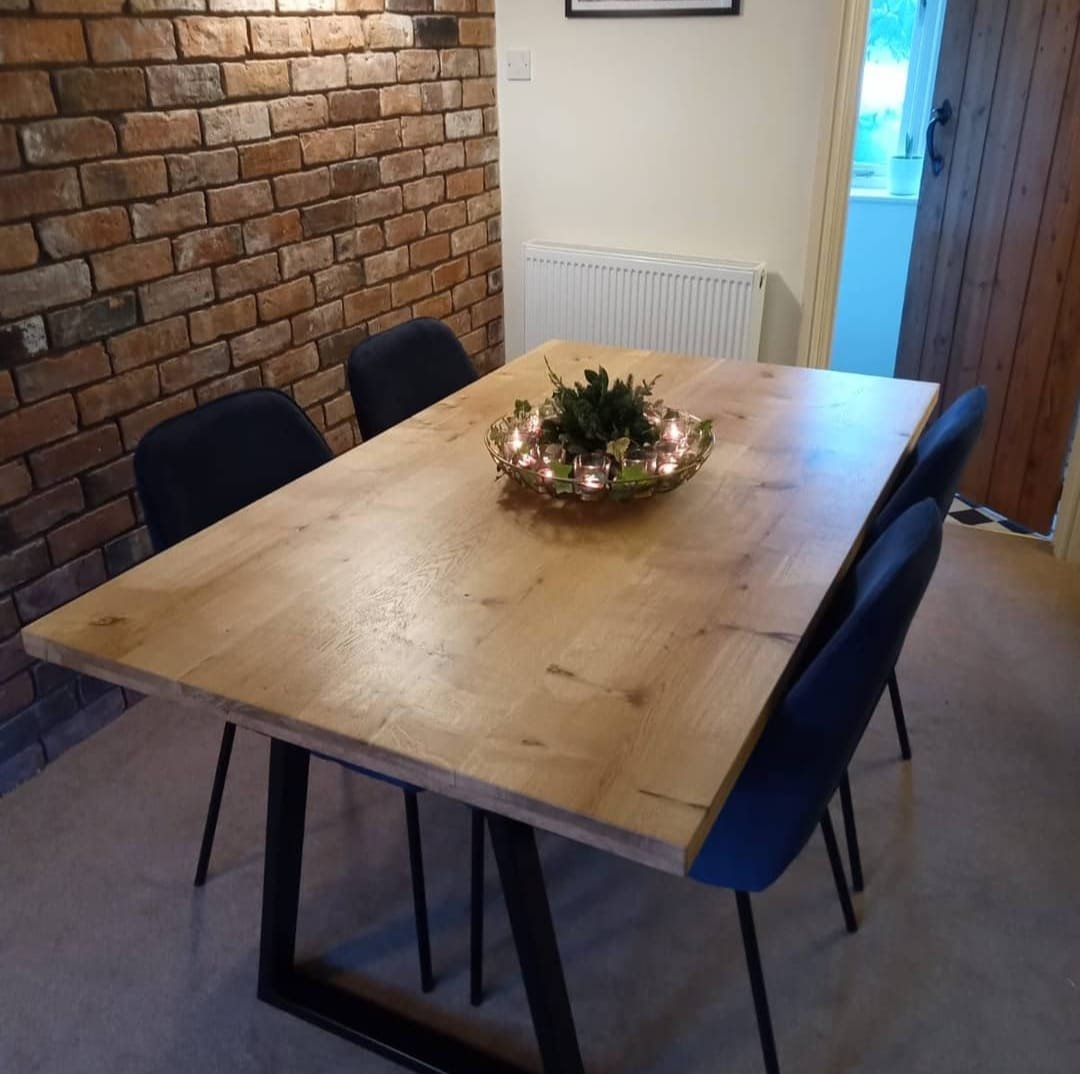
This table had suffered at the hands of an over-ripe Halloween pumpkin which had left a large damaged patch on the surface of the wooden table top. In the Highwood Furniture workshop the old varnish was stripped back and removed, the table top fully sanded, edges re-routered and then all refinished with Osmo. This will give this old table a new lease of life and ready to face the demands of a busy family life.

At Highwood Furniture we have experience in a range of restoration jobs, from restoring structural stability to dining chairs, repairing drawers, re-sizing much loved furniture pieces, re-finishing table tops, counter tops, and cabinets right through to more technical repairs of historic pieces. For example in recent months we restored a tambour slide doctor’s desk dating from the 1800s.

For each piece we will undertake any restoration and refurbishment respectfully, taking into account the history of the item and the wishes of the owner. By reintroducing a new lease of life to historic pieces they are able to carry forward the quality of the past into the future, maintaining not only the historic value, but also respecting values so important to the modern day like sustainability and a circular economy.


For further information in anything in our blogs feel free to get in touch.

Or reach out if you would like to find out more about commissioning your very own piece of custom handcrafted bespoke furniture: counters for business premises, kitchens, tables, cabinets, fitted bedrooms, chairs, beds, wardrobes, shelving, sgian dubhs, jewellery, wholesale gifts, and many more. Design visits can be organised throughout Tayside; Perthshire, Angus, Dundee, and Fife. Online consultations are available for those based further away in Scotland and the UK.
For Shop: Click Here

Info on commissioning a piece of furniture: Click Here

Or for the Care of your wooden item: Click here

How to commission your own piece of custom wooden furniture

Discover how to commission bespoke furniture with Highwood Furniture. Learn about our custom furniture design process, from concept to creation, tailored to your space and style.

At Highwood Furniture, we believe that your furniture should reflect your style, your space, and your story. Commissioning a custom piece is more than just buying furniture—it's a collaborative journey toward creating something truly unique. Whether you’re looking for a handcrafted dining table, a statement coffee table, or built-in cabinetry, our process ensures every detail aligns with your vision.

In this guide, we’ll walk you through what to expect when commissioning a bespoke furniture piece from Highwood Furniture.

Why Choose Custom Furniture?

Custom furniture offers a level of craftsmanship, quality, and personalisation that off-the-shelf pieces simply can't match. Some of the benefits include:

  • Tailored Dimensions: Perfectly fit your room layout.

  • Unique Design: Match your personal style and home décor.

  • Premium Materials: Choose sustainable hardwoods and finishes.

  • Timeless Craftsmanship: Built to last for generations.

Step-by-Step: Our Custom Furniture Process

1) Initial consultation

The process begins with a conversation. During your initial consultation, we will discuss:

  • Your ideas and inspiration

  • The intended use of the piece

  • Measurements and space requirements

  • Wood types, finishes, and design preferences

  • Budget and timeline

Whether you already have a design in mind or need guidance, we’ll help shape your vision into something tangible.

2) Design and Quote

Following the consultation, we’ll prepare a detailed design proposal. This includes:

  • A preliminary sketch or digital render

  • Material selections

  • Construction techniques

  • Estimated timeline

  • Transparent pricing

We’ll collaborate with you on revisions until the design is perfect.

3) Timber selection

We work with a curated selection of sustainably sourced hardwoods, including:

  • Elm

  • Ash

  • Oak

  • Sycamore

Timber is sourced locally, from local sawmills who source sustainable Scottish timbers, or tree-surgeons and other local sources. We select timber specifically for your project, taking into account the features of the wood and identifying characteristics in the timber that will carry across into making your bespoke furniture piece truly unique and naturally beautiful.

We will also discuss with you options for finishes to suit your interior, and help you to understand what care is required with each of these.

4) Furniture Build

Once everything is approved, we begin handcrafting your piece in our Highwood workshop. Years of experience are brought to every project, combining traditional techniques with modern precision.

You’ll receive progress updates, and we’ll gladly send photos or invite you to the workshop for a visit.

5) Delivery and Installation

When your piece is complete, we arrange for careful delivery and professional installation (if required). Every item is quality-checked before it leaves our shop to ensure it meets our high standards—and yours.

What Types of Custom Furniture Can We Make?

We specialise in a wide range of bespoke furniture, including:

  • Dining tables and benches

  • Coffee tables and side tables

  • Media units and bookshelves

  • Wardrobes and chests of drawers

  • Built-in cabinetry and shelving

  • Kitchens and fitted wardrobes

Whether rustic, contemporary, or minimalist, every piece is made to fit your aesthetic and space.

Ready to Start Your Custom Furniture Journey?

Commissioning a piece of bespoke furniture with Highwood Furniture is a rewarding experience from start to finish. We are here to guide you every step of the way, ensuring the end result is something truly exceptional.


For further information in anything in our blogs feel free to get in touch.

Or reach out if you would like to find out more about commissioning your very own piece of custom handcrafted bespoke furniture: counters for business premises, kitchens, tables, cabinets, fitted bedrooms, chairs, beds, wardrobes, shelving, sgian dubhs, jewellery, wholesale gifts, and many more. Design visits can be organised throughout Tayside; Perthshire, Angus, Dundee, and Fife. Online consultations are available for those based further away in Scotland and the UK.
For Shop: Click Here

Info on commissioning a piece of furniture: Click Here

Or for the Care of your wooden item: Click here

What to do when your wood has a wobble

Wood is a beautiful and dynamic material to work with, and one of the important skills to learn when building an ability to create beautiful and functional furniture is how to anticipate how wood will change and adapt to its environment. Another skill is how to work with timber that will likely have warped, cracked and changed as it has dried out ready to be used. As you can see from the picture - sometimes this warping can be really quite severe, and if you can imagine trying to flatten the piece of wood pictured purely by planing and/or sanding you would be left with very little. At best, using the example shown, this would be half the thickness you started with.

We buy all of our timber rough sawn - that means that it has been cut into planks soon after being felled and then has been left to season, and possibly even kiln dried, but that it hasn’t been processed in any way beyond that initial planking. This means that for us, the first stage of any project is milling and processing the timber to get it to a form that is ready to be made into whatever it will later become. Thicker timber generally costs more to buy, and when we select pieces that we will bring home we need to take into consideration how much material will be lost as we transform a piece into the nice straight processed timber we require for a piece of furniture. This means the level of additional thickness required will depend on the size of the finished piece as well as the level of warping that might need corrected. The longer the piece needed the more likely it is that more wood will be lost. As a consequence, where longer pieces are required for say a bed or wardrobe the straightness of the raw timber is of even more importance.

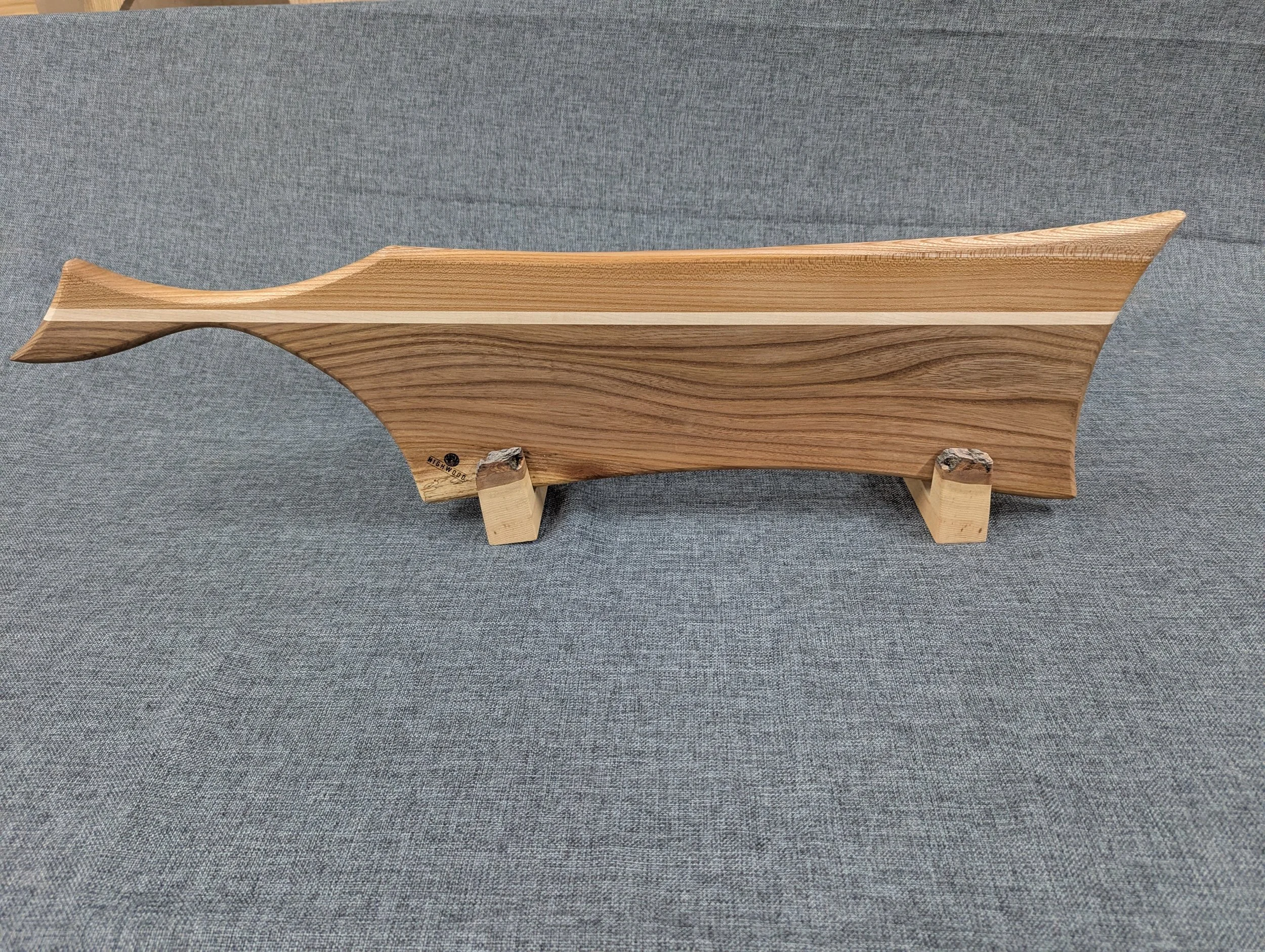
For almost all of the pieces that we, and all good woodworkers, make, even where the final piece is to be made from a single piece of timber, an important part of the process is to rip the wood into lengths and re-join them. This not only allows us to address any bends that have occurred through the drying process, but allows for a stronger final piece as it is less likely to warp in changing atmospheres. In some of our cheese and serving boards you will see that this technique has also become part of the design feature as we have used the opportunity to join different types of wood together contrasting or complementing wood colours or grain patterns. Where a single piece of timber is been used for a table top or board without using this technique it will often lose shape through warping. You will, if you look closely, be able to see the join lines in a big expanse of wood such as a table top where it has been well-made; this is a sign that your table top will be more stable and stand up with more resilience to atmospheric changes.

For further information in anything in our blogs feel free to get in touch.

Or reach out if you would like to find out more about commissioning a Highwood piece: kitchens, tables, cabinets, fitted bedrooms, chairs, wardrobes, sgian dubhs, and many more

How often should I sharpen my tools?

A question to which the answer is always “yes”

As the saying goes, a bad workman blames his tools, but what the saying doesn’t allow for is that a tool cannot be expected to do its job without also investing the time in taking care of them. Or as another saying goes, a blunt knife is a dangerous knife, the same applies to chisels. Even just honing with a leather strap will give it a slightly better edge and you will soon realise how much easier it is to work with a sharp chisel. We all know it, but it is all too easy to fall into bad habits of not doing so.

The quality of a finished piece will be impacted by the quality of the tools used to make it, in particular the level of maintenance that has been put into ensuring they are able to do the job. However, for you as the person using those tools, the biggest difference you will notice will be in the ease in which you can use them.

Whether you use wet stones, oil stones, or sandpaper, or a fancy machine sharpening your tools is important. There are many ways to keep your blades sharp, none are particularly superior to others. In our workshop, we use a sharpening machine, but suggest that if you are investing in equipment to maintain your tools that you take the time to research what would be best suited to your requirements. The benefits of a sharpening machine is that it can be quick for honing and top ups and you don’t need to set up a guide. This suits us for being able to regularly keep on top of maintenance of our tools. The downsides of this approach is that it is slow for doing a full reshape or sharpen and it can over heat the blade. The sandpaper used by a sharpening machine wears out quickly as opposed to water stones which are much more hardwearing.

Top Highwood Furniture tips for keeping your tools sharp:

  • store in a dry place

  • hone before each use

  • have a sharpening station set up in the workshop to make it less of a chore to keep things sharp

For further information in anything in our blogs feel free to get in touch.

Or if you would like to find out more about commissioning a Highwood piece: kitchens, tables, cabinets, fitted bedrooms, chairs, wardrobes, sgian dubhs, and many more

Top tips for a tidy workspace

With a few jobs on the go, we took the opportunity this week to get on top of organisation in the workshop and sort stuff out. I am sure that everyone is familiar with that feeling of just how good it is to have had a good old proper tidy up and clean.

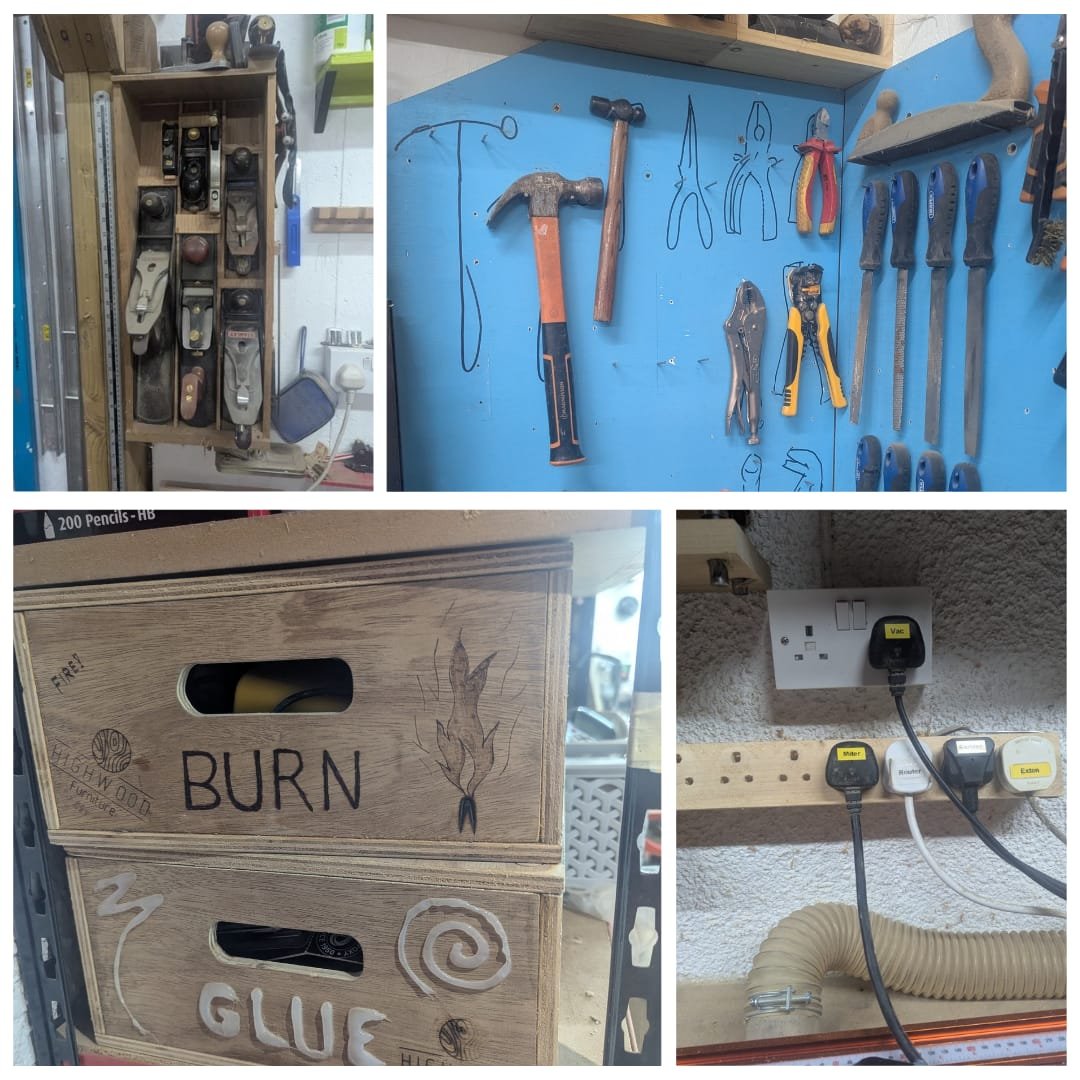
Which got us talking about what systems we like best for keeping things organised. From the classic nails and sharpie drawn tool wall through to Colin’s favourite, the wooden plug tidy where there is space for all the appliances not currently being used to be “plugged in” while they wait. The handy label maker ensures that the right plug is found first time every time.

Also pictured is the plane cabinet, each with its own space, and some boxes clearly labelled for their contents. Its so much nicer keeping things organised when you can enjoy the process of doing so. Which also allows us to be better prepared when tackling a bigger range of furniture and kitchen design, build and restoration projects.

Let us know your favourite workshop/workspace organisation tips?

Image showing a tool wall with tool outlines drawn, labelled boxes “glue” labelled using glue, and “burn” labelled in pyrography, a plane cabinet, and a wooden plug tidy with labelled plugs below the main wall socket.

Who are the hardest working members of the team?

We have a fair number of friends in the workshop that help us out with making Highwood Furniture, and those who follow our social media will have on occasion seen them make an appearance - sometimes these might be our four legged friends, but more important for getting the job done are the inanimate, but by no means lacking personality, characters that help us out.

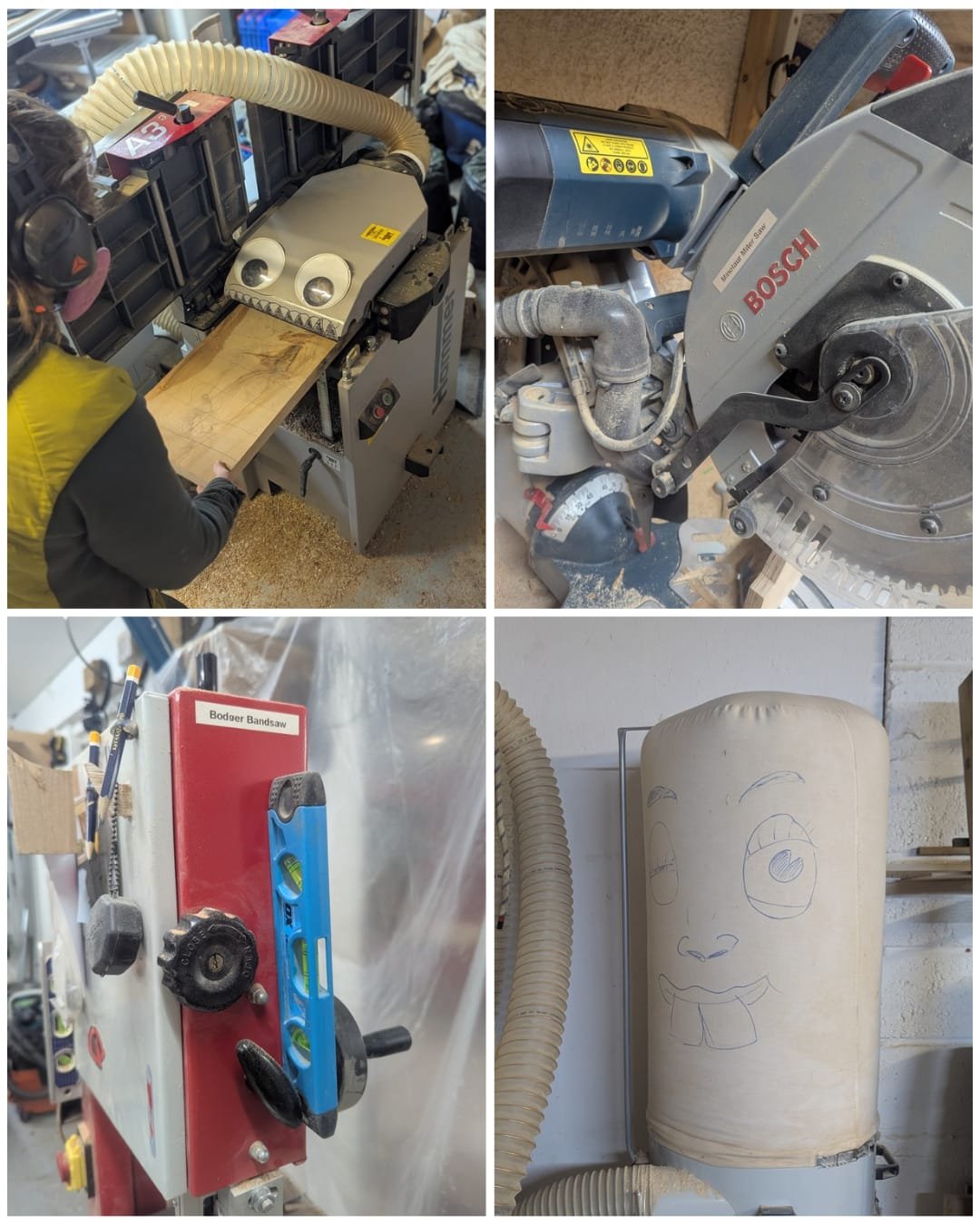
We thought we would use this weeks blog to introduce some of these. From Ernie our trusty dust extractor who keeps our workshop air clear and healthy, to googly eyed Theo the thicknesser who works super hard in processing our timber to the dimensions required for our projects. He is part of the process for almost every piece of wood that comes through the workshop - whether that be for a cheeseboard, a cabinet, or a full on kitchen. Theo works hand in hand with his alter ego Polly planer whose expertise is similar to Theo’s, just on the other side of the same piece of wood.

They don’t all have eyes though, there are many more “affectionately known as” names carefully dotted around the workshop. Pictured you can see good old Minotaur Mitre Saw who steps up when cross cuts and angles are required - especially important for decorative features on cabinet and drawer faces, and in compound features of complex joinery found in some of our chairs, tables, and cabinetry. You can also see Bodger Bandsaw whose speciality is small precise cuts and irregular shapes and patterns. Bodger also takes part in many different projects, but is particularly useful when shaping some of the rough pieces ahead of refining for handles, sgian dubhs, and is also handy for cutting out shapes for inlay features.

Let us know if you would like us to introduce other members of our team, perhaps our latest addition Sandy McPolish, our new random orbital sander will put in an appearance soon?

Who designs better furniture: Artists or wood-workers?

With a few projects in the design stages at the moment in the Highwood furniture workshop there are a lot of ideas bouncing about. And this raises the question of what makes a great design?

Design is in no doubt as individual as the designer, and the approaches taken can be as equally as diverse. Good design enhances our lives, it is beautiful, practical, and hits the balance between the two in just the right way. Functionality and style need to go hand in hand, and it will meet the style and personality of its surrounds and the people invested in it.

To coin a corporate phrase blue-sky thinking should be every bit as important for your next piece of furniture as it is for your boardroom planning. While sometimes a design may focus heavily on the practical requirements, for others it is about really thinking outside the box and introducing something truly unique and special into your environment.

At Highwood furniture we work with carefully selected locally sourced sustainable Scottish timber, and the beauty of the materials we work with often carry the weight of the “beauty” side of a design. This allows us to focus on simplicity and functionality to provide you with a one off piece. High standards of workmanship, detailed cabinetry, and high quality finishing make all the difference in doing justice to the beautiful natural resources we work with.

At other times the vision (and unfortunately also the budget) of the client, and the environment the piece is destined for lend themselves to being able to reach for the sky when it comes to design. Colin’s artistic flair can then come into its own. Where this situation arises Colin likes to throw in some random design ideas off spec as part of the design process. He finds that this demonstrates a different direction which can then bring out new ideas.

It is also important for us, as designers to consider what we are designing, and what skills are important. It is easy to focus in on the functional and practical nature of the project in hand. How many cupboards will fit in a space? What would “normally” be the layout of a wardrobe in these circumstances? What is the build structure of a bed or table in most circumstances? In this way, if a design is created based on how it will be built the creativity can be stumped. When we are designing we like to start with a vision, and build that vision first before building the furniture. Only when this is done is it time to introduce the practicalities and find a way for the vision to be made into reality. Arguably it is easier to design inspired artistic pieces of furniture before having the knowledge of how to build them.

What does this mean for you if you are commissioning a piece of Highwood furniture?

House/site visits are important part of the process, drawings can begin to take shape at an initial visit when you are present. A visit also allows us to get a feel for your style and personality which is so important in making the right piece for you. In this way, the design process starts with rough sketches. We may go away and build on these and come back to you with more detail. Once a direction and ideas have been generated then more detailed plans will come together, possibly, but not always, using computer software. For some pieces there may be multiple design visits, with changes made at each until we get it right - in partnership with you.

So who does design better furniture: An artist or a wood worker? Perhaps the best furniture comes from someone who is both? Someone who can pair artistic vision with functionality using wood.

Do you know a lap joint from a bridle joint?

A recent project that came through the Highwood Furniture workshop prompted the use of a range of different joinery techniques, and therefore invited the opportunity of using this weeks blog to reflect on these and why they are used.

For those who enjoy and appreciate, but perhaps don't make furniture, the difference can sometimes be mystifying. Good joinery is beautiful, and we can all appreciate the feel of a piece of furniture that we have confidence in. Good design brings together aesthetic beauty with strength and longevity.

For this particular project, the brief was for a table to complement the beautiful new kitchen the customer had recently fitted. The key feature was a large oval quartz table top in the same material as the kitchen countertop. Because of the weight and dimensions of this table top it was even more important than ever that balance and strength were at the forefront of the design. Other features selected were clean lines, and the timber of choice was oak to bring classic understated quality into the equation.

When choosing the type of joinery we will use for a piece of furniture, a number of factors are taking into account. Strength and durability and the way that joints will allow the timber to move as it adapts to its environment are key when considering the initial suitability of a type of join. The type of timber used for the piece may have an impact on what will be most suitable, as will the angles and pressures that will be required by the design. Where forces that may impact on structural integrity are minimal, there are times when joins are chosen for their simplicity and therefore cost and efficiency. It might also be that joinery is chosen for and is an integral part of the aesthetics of a piece, for example in a display box that Highwood furniture created for an artists materials hand cut dovetail joints were important to the high-quality intricate detail requested.

Choices made will differ depending on what is being made, table, cabinet, bed, etc. In the table described above the decision was made to use a lap joint where the timber crossed at the base of the structure, a bridle joint for each of the angled joins, and slip joints where the structure for the table top is supported by the main frame. These are illustrated in the picture alongside this blog.

We invite you to take a look at the furniture you come across in your life, it is truly fascinating to look at details and qualities of cabinetry in relation to its quality, structural integrity, and ultimately longevity.