
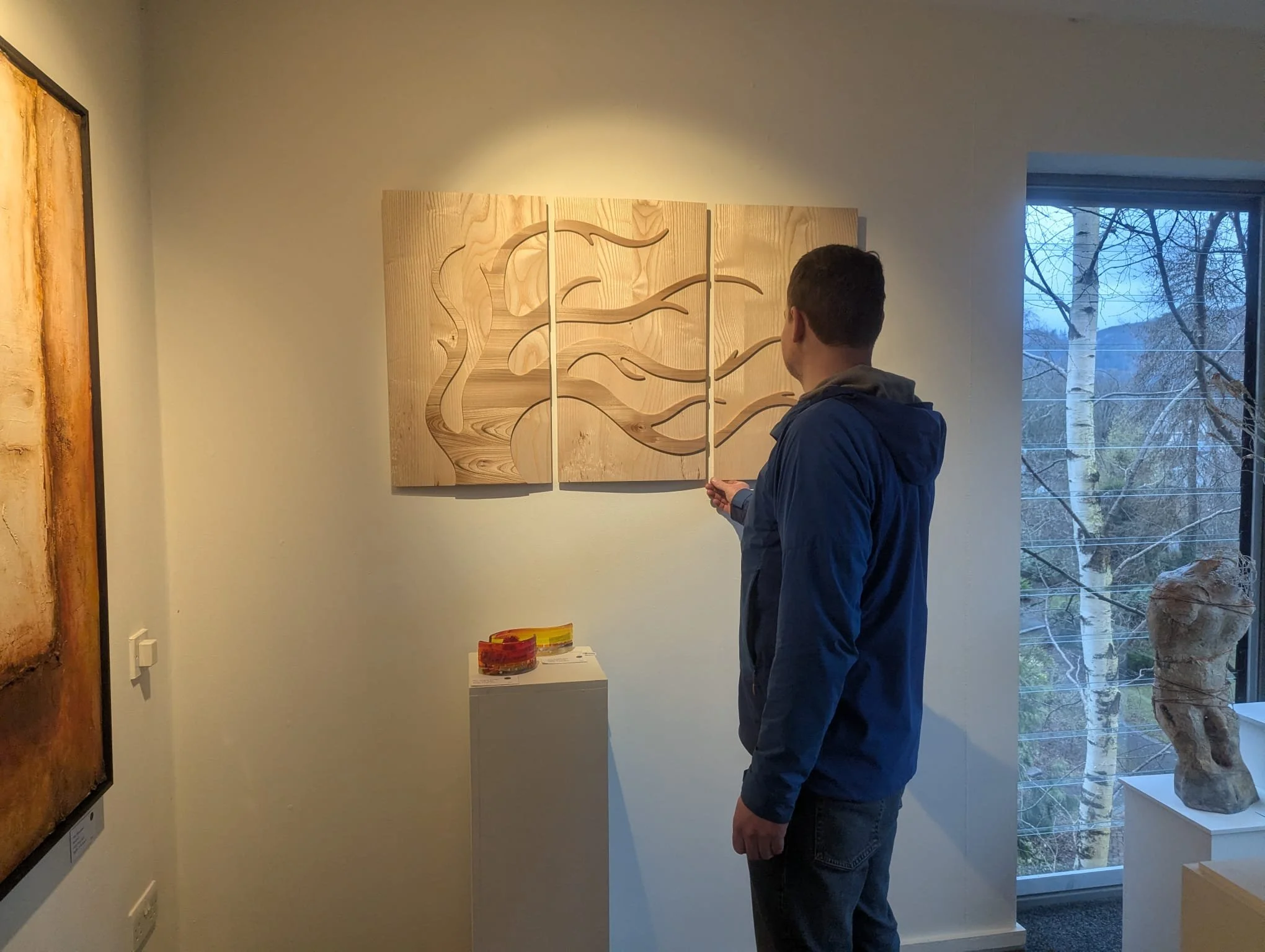
On a recent visit to the ongoing Perthshire Artisans exhibition at Birnam Arts we were particularly struck by the changes that had occurred in the loopy desk as a result of the extremely hot and dry environment at Birnam Arts. What had been perfectly level joints when the desk entered the gallery were now as much as 2-4mm difference between the main top and the breadboard ends. This is a difference in a desk that has been part of our lives now for many years, it is a well loved, and well tested piece that lives in our home. It also spends a lot of time through the summer in particular being transported from pillar to post as it is used as a display piece at markets and events so is well versed in the pressures of environmental change. The change we saw isn’t a reflection of changes in undried wood in a new piece of furniture. There was also evidence of the impact of the extremely dry atmosphere in the decorative wall panels - with a slight warping of the large ash panels. In this piece this change isn’t a problem, the design can handle these atmospheric changes. Where you can see it is in the photo above where it is exaggerated by the slight curve to the shadow that you can see below the panels. While this change isn’t significant for this piece, what they illustrate is the importance of features such as a breadboard end for pieces (like a desk) where this change would matter. Like the breadboard ends that can be seen on the loopy desk.
Therefore, despite this 2mm, perhaps being a seemingly undesirable flaw, it is far more an indication of the quality of the furniture that Colin designs and makes. And his concern about that 2mm difference; a reflection on his desire for the perfect finish.
Of course, wood moves, and it is common knowledge that this is a characteristic of the material. In all our furniture we used well dried timber - more often than not kiln dried, and it will usually have spent many months acclimatising in our workshop. The environment in our workshop is kept warm, but more importantly it is kept dry, with the use of dehumidifiers to minimise the chances of our timber being affected by moisture in the environment. All of this is done to minimise the impact that the environment will have on the furniture when it moves into a nice warm dry house.
Of course, once furniture has settled in the environment that it is to be kept then adjustments can be made to any of these quirks that may appear, although in most cases they won’t even be visible.
Good furniture design embraces this characteristic in wood and uses techniques which have been developed over centuries to allow structural integrity that works with the natural movement of the wood. These techniques are used to minimise, and even eliminate the possibility of problems such as cracking and splitting, warping, and joint failure. Wooden furniture that has been built without an understanding and sensitivity to this characteristic will often distort, crack, or even structurally fail.
Examples of these techniques include:
Breadboard ends - to provide a mechanical advantage, preventing movement in end grain and minimising the potential for cupping or warping of large flat panels - used particularly in desks which might otherwise be prone to warping or cracking
Floating panels: within a door for example, allow for expansion and contraction without compromising the structural integrity of the piece.
Mortice and Tenon: the tenon (the projecting part) is slightly smaller than the mortise (the hole it fits into) in the direction of wood movement (typically the radial direction for quarter-sawn wood). These then sit freely allowing the tenon to slide slightly within the mortise as the wood expands and contracts
Domino Joints: the oval shapes allow for expansion and contraction in the wood while also maintaining stability
Partially glued box joints: partial glueing allow for movement along the length of the joint.
If you would like to find out more, or if you have a question about why a piece of your own furniture behaves in a certain way feel free to get in touch.
For further information in anything in our blogs feel free to get in touch.
Or reach out if you would like to find out more about commissioning your very own piece of custom handcrafted bespoke furniture: counters for business premises, kitchens, tables, cabinets, fitted bedrooms, chairs, beds, wardrobes, shelving, sgian dubhs, jewellery, wholesale gifts, and many more. Design visits can be organised throughout Tayside; Perthshire, Angus, Dundee, and Fife. Online consultations are available for those based further away in Scotland and the UK.
